
Clark County Previous Resident Sources
No single roll spans the full life of a Clark County address. The useful source changes with the year. Modern parcel and deed indexes can establish a legal chain, but older household evidence may survive only in a directory, census schedule, newspaper, cemetery record, or library collection. The table separates ownership evidence from occupancy clues so a recorded party is not casually labeled a resident.
| Source | Clark County span | Access point | Best evidence |
|---|---|---|---|
| Landmark recorded-document index | Online from 1961 | Clark County Auditor | Recorded parties, dates, filing numbers, parcel or legal clues |
| Vancouver city directories | 1882–1996 described locally | Reading-room books and microfilm | Names, addresses, years of residence, and roles when printed |
| Federal and territorial census | Public schedules vary by year | Archives and licensed library databases | Household members and dated place context |
| Clark death register | 1891–1907 | Washington Digital Archives | Indexed death and image evidence |
| Historic maps and surveys | Address and collection dependent | CCHM, county partners, Library of Congress | Buildings, lots, street names, and historic-property context |
For a late twentieth-century question, start with the current parcel, then move through Landmark and directory volumes. For an early address, begin with the best dated directory or map and work both forward and backward. Before 1890, a missing result is often a repository gap, not proof that no household existed.
Clark County Deeds Backward
The Clark County Auditor Landmark index is the main online route for recorded documents from 1961 forward. Search modes include name, document, parcel, book and page, filing number, and legal description. A name form can use last and first name, a match choice such as starts with, contains, or equals, a document category, and a date range. Save the party spelling, category, recording date, Auditor filing number, and any book, page, parcel, or legal field shown.
The index is a finding tool. An online image is not a certified copy, and image purchase may require an account. When a document matters, request the instrument from the Auditor Recording Office online or at 1300 Franklin Street, second floor, Vancouver. Phone and email access are available at 564-397-2208 and recording@clark.wa.gov.
The Landmark screen below shows the official search entry point used to trace Clark County previous residents through recorded-party and parcel clues.
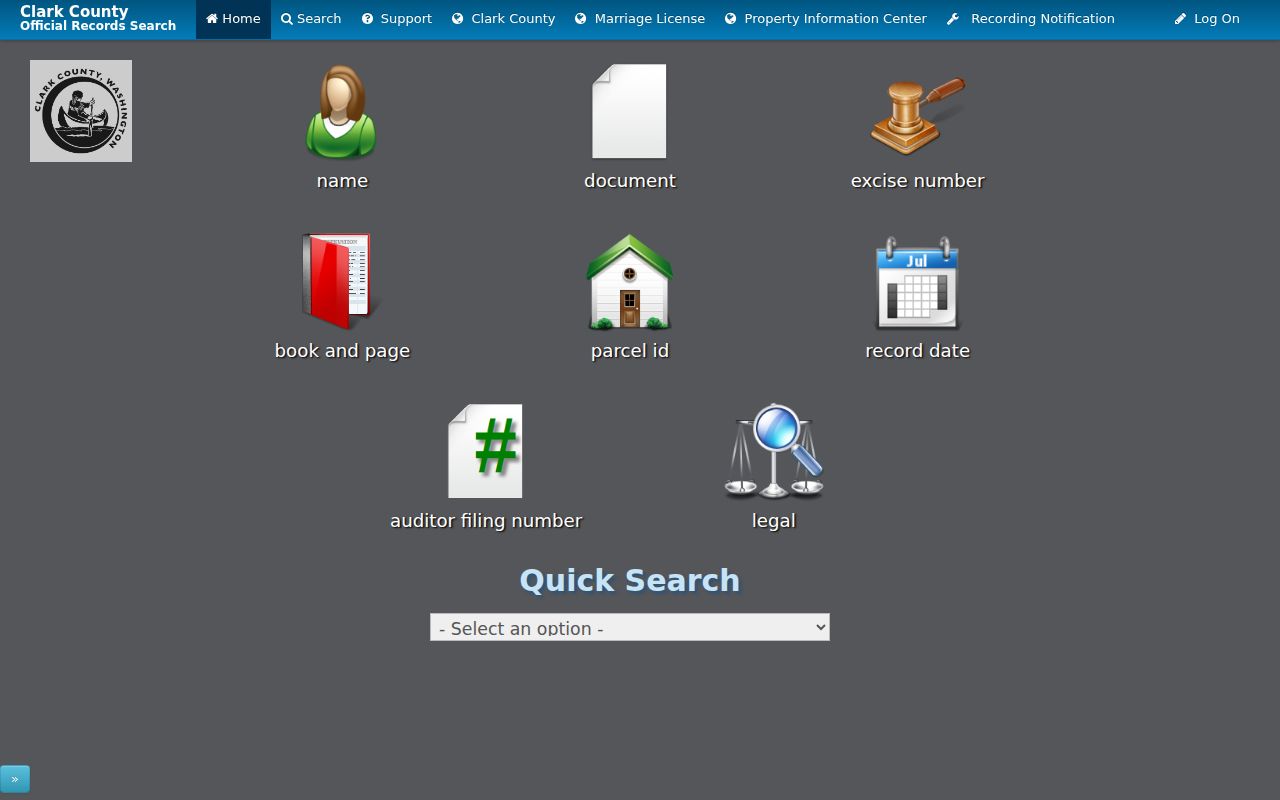
Its several search modes matter because older deeds may be indexed under a trust, estate, business, name variant, or legal description rather than the current street address.
Trace Clark County Previous Owners
A chain of title is the sequence of recorded transfers for one parcel. Start with the current parcel in the Property Information Center, then use the newest deed to identify the party who conveyed it. Repeat with exact references. This process identifies recorded parties, not all previous residents, so keep a separate household timeline.
- Search the Property Information Center by tax parcel, house number, or partial street address. Save the parcel ID, situs address, jurisdiction, and legal description shown.
- Find the newest related deed in Landmark. Record the filing number, recording date, named parties, and any prior deed or book-and-page reference.
- Search the seller as a grantee, the party who received property in the earlier transaction. Use date limits and name variants to reduce false matches.
- Follow each cited instrument backward. Confirm that the legal description remains tied to the same land even if the parcel number or street form changes.
- At the 1961 online boundary, ask the Auditor about book, microfilm, or archive access. FamilySearch catalog material also identifies Clark deed and index collections with older spans, though image access varies.
- Grantor
- The party who transfers an interest in a recorded instrument.
- Grantee
- The party who receives that interest.
- Chain of title
- The linked series of transfers associated with the same land.
- Legal description
- The formal land description that can survive renumbering, road-name changes, and parcel adjustments.
Note: A deed proves a recorded transaction; it does not prove that every named party lived at the street address.
Clark County House History Route
Clark County’s historic-property research guide gives a local sequence after the legal chain: deeds, directories, newspapers, photographs, maps, tax or assessment context, and historic nomination files. Use a worksheet with one row per source. Record the date, exact address spelling, named person and role, document ID, repository, and confidence level.
The Clark County Historical Museum holds a non-circulating research collection with Polk directories, maps, historical-home surveys, newspapers, oral histories, cemetery records, and topical boxes. Storage areas are closed, and help is limited, so arrive with an address and date range. Pencils and a camera or scanner are useful; pens are not allowed.
The CCHM research library page pictured below shows the local collection route for previous-resident and house-history work.
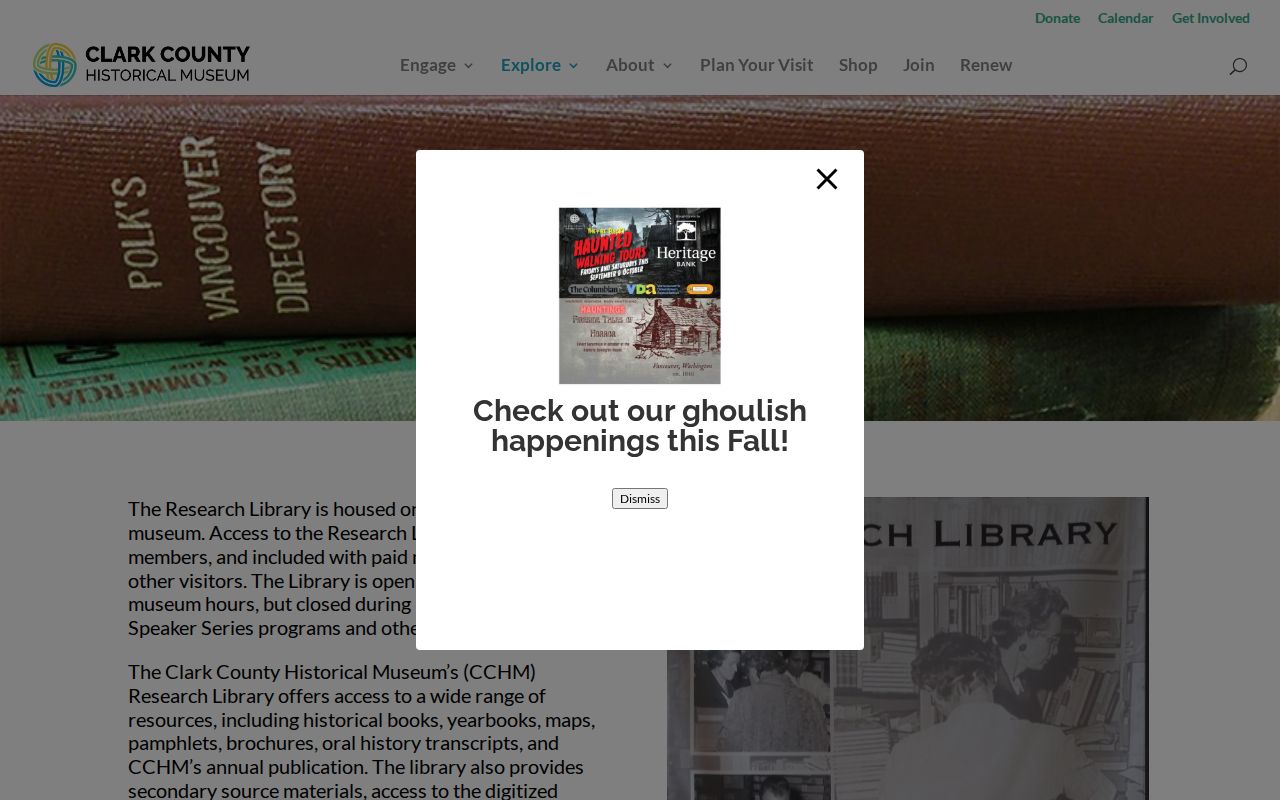
That library is a catalog and staff-assisted route, not a complete online name index. Confirm hours, permissions, and item availability before a visit.
Why Clark County Records Vanish
A courthouse fire on November 24, 1890 destroyed virtually all county records then held from Clark County’s establishment. The loss explains why a clean county-index search cannot settle an early house question. Later deed recitals, territorial or federal material, a newspaper, church or cemetery record, private papers, or a copied directory may preserve the only trace.
Clark County began as the District of Vancouver in 1844, became a county in 1845, was spelled Clarke after 1849, and returned to Clark in 1925. Those changes affect catalog searches. Try Vancouver, Clarke County, and Clark County with the street, family name, or legal description. Label a missing era as a gap instead of filling it with a nearby date.
Map Clark County Past Residents
The 1892 Vancouver Sanborn map set contains nine sheets. A sheet can show a building footprint, lot context, street label, and nearby structures. Match the sheet number and street form to a directory or deed from the same period. A mapped building is useful physical evidence, but it does not identify an owner or occupant by itself.
Historic-property surveys may add construction or alteration dates, an architect or builder, prior names, photographs, and deed references. Treat that narrative as attributed research, not a continuous title chain. This map-and-survey layer is especially useful when a modern parcel contains an older structure or the address form has changed.
Pair Clark County Directory Years
Ownership and occupancy often diverge. Vancouver reading-room holdings describe city directories from 1882 through 1996, with books and microfilm complete to 1929. An entry may contain a name, address, role, spouse or household marker, telephone, and owner or occupant notation, but fields vary by volume. The full collection route belongs on the Clark County city directory page.
- Choose a directory year close to the deed date. Copy the entry exactly, including initials, abbreviations, street prefix, page, title, and repository.
- Check the same address in the next available volume. A move, omission, boarding house, or business listing can change the result.
- Pair the address with a public census schedule near that year. Compare household placement and age or birthplace fields without modernizing historical labels.
- Use a same-period newspaper, cemetery record, voter list, or deed as an independent check. Keep occupant and recorded-party columns separate.
- Criss-cross directory
- A directory arranged by street, address, or telephone rather than only by surname.
- Enumeration district
- The geographic area assigned to a census taker; boundaries can help locate an address when no name index works.
- Source level
- Whether a finding is a direct index record, reviewed image, catalog lead, transcription, or unconfirmed clue.
Clark County’s Rural Address Clue
A Clark County Genealogical Society catalog description identifies a 1970 Rural Directory, Clark County Washington. It includes alphabetical telephone listings and reverse guides for rural neighborhoods and mail-delivery routes, with names and maps. This unusual source can bridge a rural address between a deed and later parcel data.
It is a physical catalog lead. Exact shelf placement, later editions, and online access were not established in the research. Contact the CCGS library, which is open to the public and offers librarian help, with the title, target name, route, and year. Respect the society’s copying restrictions.
Confirm Clark County Past Households
Newspapers and obituary indexes can close a previous-resident trail after a directory name disappears. Save the publication, date, page, notice type, exact name, address or locality, event, image URL, and any OCR doubt. The CCGS catalog lists partial obituary indexes and annual vital-statistics compilations for local papers. Library copies are available, and members may request an email copy. The index may guide a search but may not be republished as a new database.
Cemetery records can add a burial date, age, birthplace, plot, or record identifier. Vancouver’s local holdings describe Mountain View Cemetery microfilm for 1887–1965. Probate files may help with heirs or property transfer, but Clark County Clerk coverage varies by medium: probate film begins in 1890 for older material, while digital coverage is listed from 1997. Search or inspect at the courthouse, then request a specific case and document by number, party, type, and date.
Lawful use. Clark County previous-resident research supports house history, genealogy, and estate work. Never use a dated address trail to watch, harass, or harm a living person.
Keep the final chronology modest. A directory supports a dated occupant listing; a deed supports a recorded party; a census supports a household recorded by that schedule. Together they can show who lived here before, but each source retains its own limits.